Art & Writings
Learning the Fundamentals of Art 2025-05-26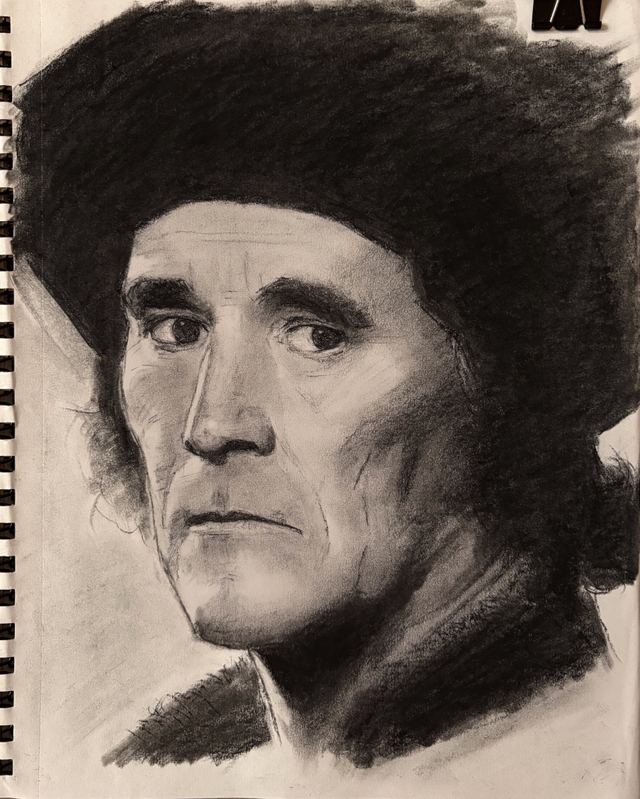
At the end of my last post, I mentioned that I would be focusing on value and rendering, and that’s exactly what I’ve done! It turns out graphite is an arduous medium for creating rendered drawings with a wide value range. At the advice of internet people, I’ve started using charcoal, a lot. The following is a chronological gallery of what I’ve been doing with Charcoal the past month. <!-- {"width":322} --> This was my first attempt with charcoal. I lacked dexterity with it, but I could tell that it was immediately easier to get a greater value range. I kind of like the drawing, but the proportions are more off than I can condone. I believe this is because I was using a lot of brain-bytes trying to manipulate the charcoal. I’ve found that when trying out new drawing skills, it causes other things to suffer a little, like my proportions here. <!-- {"width":371} --> In this attempt, I used a different type of charcoal that is a little more waxy and less dusty. I have my shadows and lights separated well here, but there’s a lack of halftones and transitional values. <!-- {"width":522} --> Now this was my first charcoal drawing that felt like something. Through my practice I had built up some dexterity with charcoal. I became more familiar with how it moves on the page and was able to spread it around with my finger to create halftones with it. Sharpening my tools properly with a razor and sandpaper also helped a lot. I like the form of her hair and the overall gesture of the head and face. <!-- {"width":322} --><!-- {"width":297} --> Then I began learning how to draw drapery with charcoal as preparation for a small project. I had to build even greater dexterity. Not only controlling values but also their hard and soft transitions, which is very important for the folds of drapery. These are semi-successful.  I really like this piece, and it’s the only art I’ve given to someone else! This is the small project that I prepped for. I had to make sure I could draw the folds of her clothes well. And charcoal doesn’t always erase well, so I knew I couldn’t totally botch it. My youngest cousin had taken some interest in drawing the past few months. Over the holidays she even drew with me, and I let her draw in my sketchbook, so I decided to gift her some supplies. I drew this in a sketchbook and sent it to her. The reference is a photo of [*The Annunciation* sculpture by Sigrid Blomberg](https://swedishmuseum.org/2021/05/21/the-annunciation/).  I did this piece for a bi-weekly challenge that is held by the internet forum I’ve joined. It took about 4 hours. I’m pretty happy with the rendering, but the proportions look slightly goofy. As a result, I vowed to never again allow a drawing to fail due to its proportions. What am I, an amateur? I also like the composition, which has been something I’ve made a priority, even in more casual sketches and drawings. It makes a surprising difference, even if the drawing itself is subpar.  In my vindication, I came back with this 6 hour study. Not only was I able to go very dark with the charcoal, but I could also spread it around with my finger, which helped make the midtones you can see in places like the side of the nose. I used an eraser to emphasize the highlights. I’m especially happy with this since I managed the complex lighting situation where his face is lit by ambient light and also a brighter light source shining from the left. The proportions, values, and composition are all done well. Charcoal is such an excellent artist tool. It’s what most traditional art academies will teach you with, and there’s also tons of [wonderful artwork](https://npg.si.edu/exhibition/john-singer-sargent-portraits-charcoal) done in charcoal. I would say that it’s really a necessity if you want to learn how to control values well, since it actually enables you to lay them down. I still do casual sketches in graphite, but charcoal is now my go-to for more finished drawings. If you want to learn more about charcoal and also get a hint at where my art journey is taking me, check out this [thoroughly written article](https://anthonywaichulis.com/charcoalpastel-vs-graphite-as-a-precursor-to-oil-painting/).
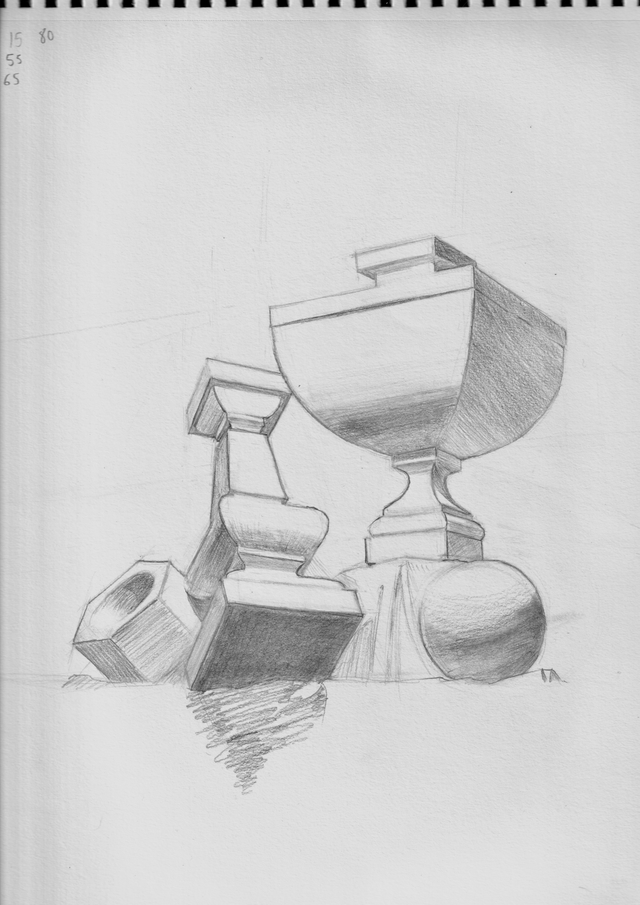
I’ve joined an internet forum where there are bi-weekly challenges, and the latest one was to draw a perspective heavy scene from a provided reference. This might be my longest drawing at nearly *4 hours*. Perspective is hard, and I decided not to use any rulers and hand jam everything. I do like how this turned out, and besides getting the perspectives (mostly) correct, I knew what I wanted to do to design this piece to look aesthetic. I needed it to be clean. The problem I saw with some other submissions (or at least something I didn’t like) is that even if they had nice rendering, their lines were messy or lacked variety.  The variety I speak of can be see among the objects above. I have keyed in lines, soft lines, and a lost line. The “keyed in” line is something I learned to do from a figure drawing instructor here in NY, and it’s where you create a dark mark to key in your value scale. You can see that I keyed in the corners of the base of the pedestal. I usually did these when the line bordered two contrasting values (light and dark), but some of that information isn’t there since there is no background. However, the key-ins create some variety and visual interest regardless. Alternatively I have softer lines or lost lines where there is less value change. The top left portion of the circle is a lost line. The line isn’t there (except for erase marks), so your brain uses context to fill in the information. Another lost line I like in this piece is the bottom portion of the hexagon’s intrusion, where the edge of the cut meets the hole. <!-- {"width":298} --> And lastly, this lost line on the shaded side where the curve meets the flat. <!-- {"width":293} --> My rendering (AKA shading) is still lacking. I can’t really even make a gradient or control my value scale, so that will be a greater focus for me in the coming weeks.
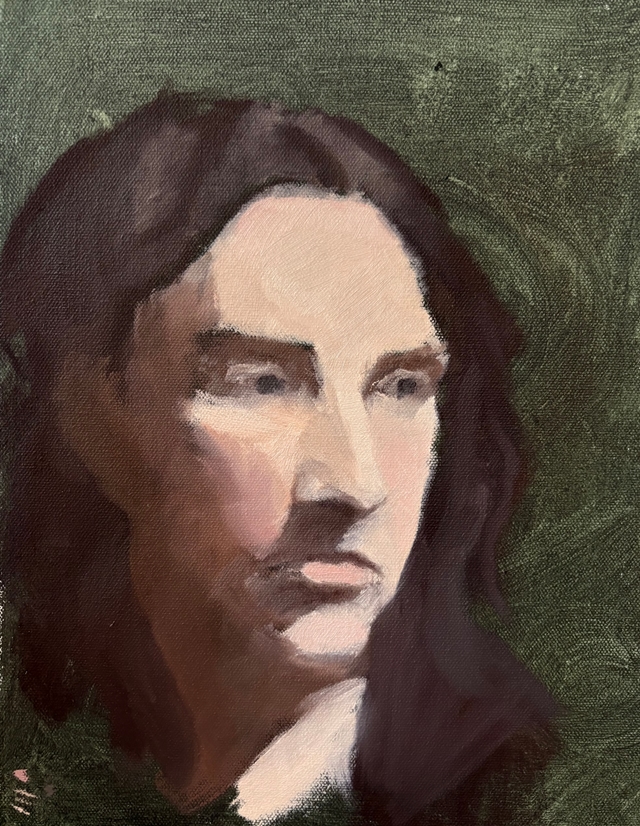
I did these paintings at a class that supplied all materials. Each painting was 2-2.5 hours, which is a relatively short amount of time for an oil painting, and they were all from a live model.  Being new to painting, there were a lot of new factors I had to consider while doing these. When putting brush to canvas, it briefly felt as if I had forgotten how to draw. A pencil or pen are precise tools so the thickness of a brush felt clumsy, but I quickly got over it as I had more important matters to attend to. Managing your paint materials is akin to managing a kitchen. You’re taking measurements and it’s messy, and you’re under the duress of finite time. Your pots and pans are your brushes, solvents, and paints. There’s a rhythm to find that makes managing everything run smoothly, otherwise you’ll be fighting your materials when you should be fighting to make something that looks like a human head on canvas.  This was my very first painting. I used a full pallet of 8 colors. We were taught to *tone* our canvasses, so the blue shade in the background is the tone. I should have made it darker, since I was painting a model with a dark background. Color hues and values are local, so changing the background color can substantially change the look of the figure you’re painting. Mixing paints is an art in itself, and here I couldn’t quite get normal, human looking colors, but she has an earthy hue that I don’t mind too much. I think I placed the shadows solidly, and her look is sort of expressive.  In my second painting, I moved to a simplified pallet of primary colors (red, yellow, blue) + white. A primary color pallet is what most painters should start with, so that you can learn what colors actually look like and what they are made up of. Adding more colors to a pallet is an acceptable shortcut that painters will begin to use later on, but for now I wanted to mix everything. I think this painting is fine. It looks more like the model, and I have real colors going on. However, it’s mostly two tone. I have the hard shadows and lights, but I’m missing most of the transitional values.  In my final painting, I continued with the primary color pallet, and I also used two separate brushes for light and dark values. This made applying paints considerably easier. Something substantial I learned from my instructor during this painting is that I should consider the color of the shadows. Cold colored shadows can make a figure look lifeless. I tried course correcting to warmer shadows near the end of the session. I also have a nice value transition on the cheek. Overall, I loved doing oil paints. It adds a whole new dimension to drawing, and I love wrangling the complexity of it all. I can’t wait to do more, and it’s piqued my interest in the paintings of Masters. But, the basis of all art, even painting, is still drawing!
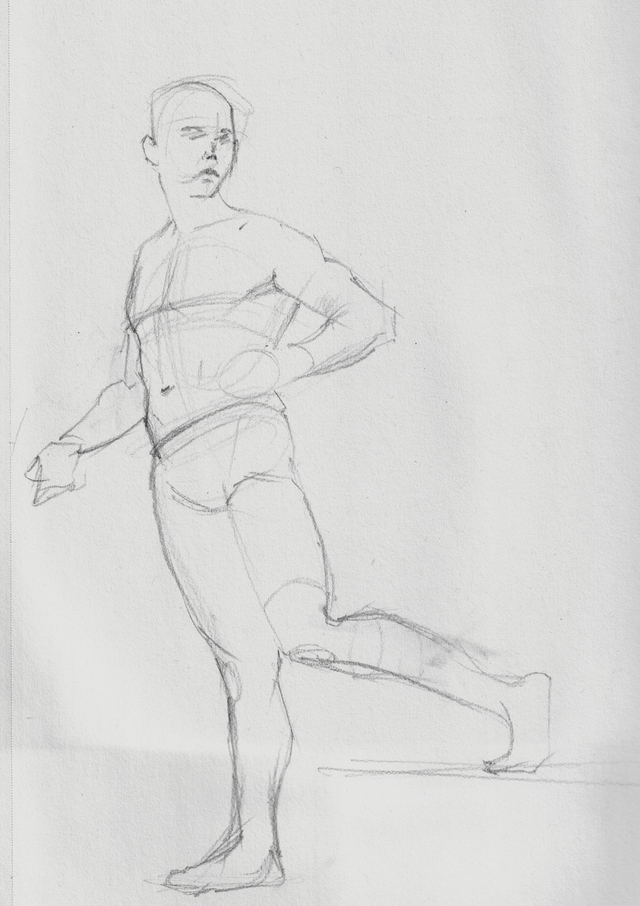
I enjoy this sketch due to its simplification of forms and subtle gesture. The figure isn't in an extreme pose, but the tilt of the pelvis and shoulders, raise of the arms, and turn of the head accumulate to create a very dynamic gesture. I drew this from a photo reference, but it reminds me of the expertly elegant and subtle gesture found in Greek statues of which I've had trouble recreating in the past. I'd like to shore up the hesitancy you can see in the figure's lower legs. I often have trouble correctly observing the contours of the calf and shin and around the knee. An anatomy study of the legs will most likely suffice.
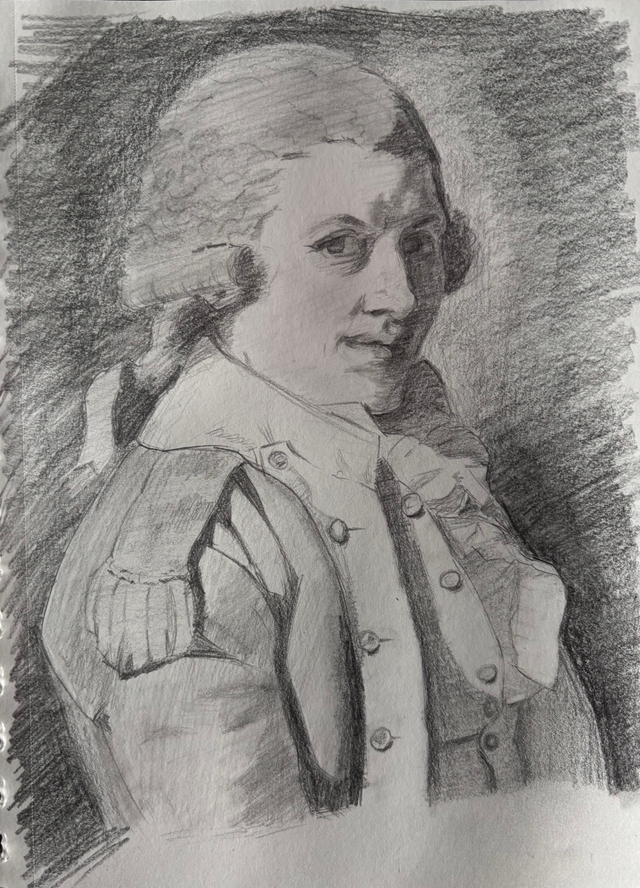
Ducreax is known for breaking convention by creating expressive portraits. He's known for much more expressive portraits than what I recreated above, but I like to think I captured the subdued smile of the reference.
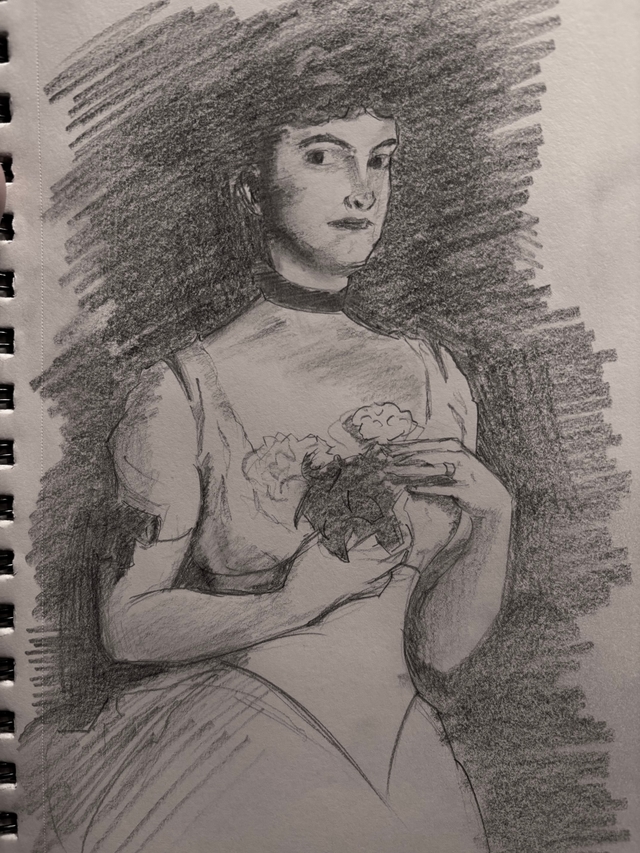
I've been getting into master studies recently thanks to an artist I've been watching called Katie Maeve, and what better artist to study from than John Sargent who is one of the most well regarded portrait painters of all time. Something I wanted to practice in this study is his use of hard and soft lines. The hard lines create contrast with the background to bring the viewer’s eye to important parts of the piece such as her face and hands, while the left side of the figure fades into black. There is also some soft lines between the flowers she holds and her dress. My implementation somehow feels heavy handed in some areas, but this was a good value and lines study for me. I like how her arms turned out, and I also like how I conveyed her face using values.
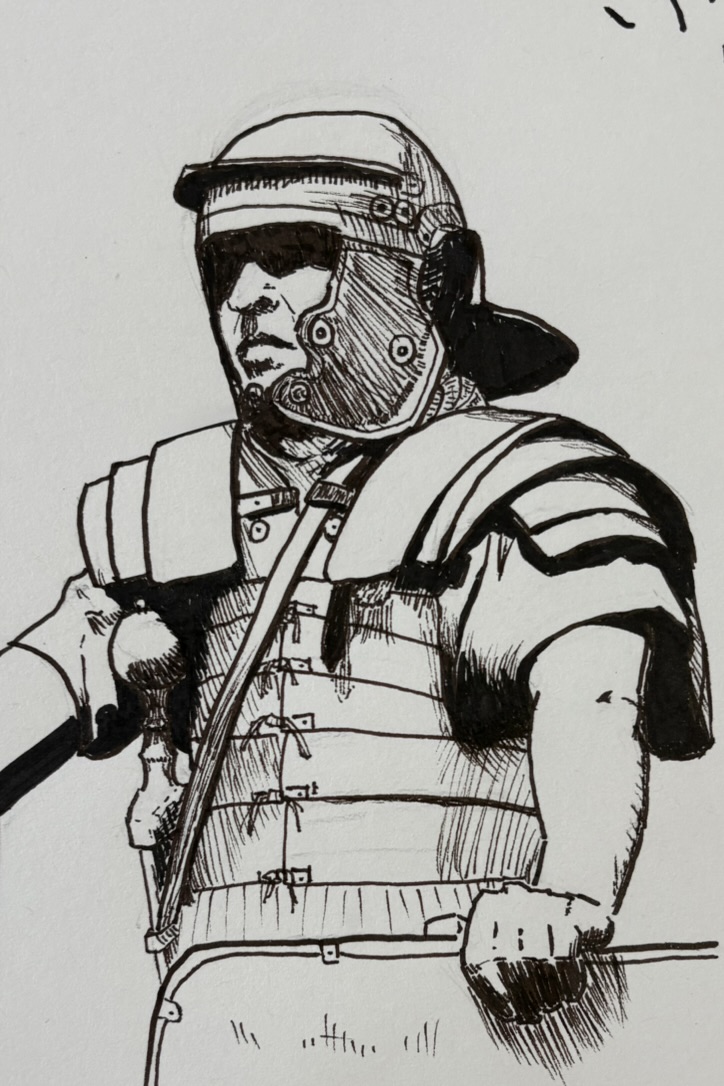
This is a continuation of my Kopinski inspired drawing. The shadows under the armor plates were hard to get right in ink, but I like the face. I took a picture of my loose pencils, so I wanted to show it here. I moved straight to inking from the sketch you see below. Notice how much more detail is in the inking. It's a practiced skill! 
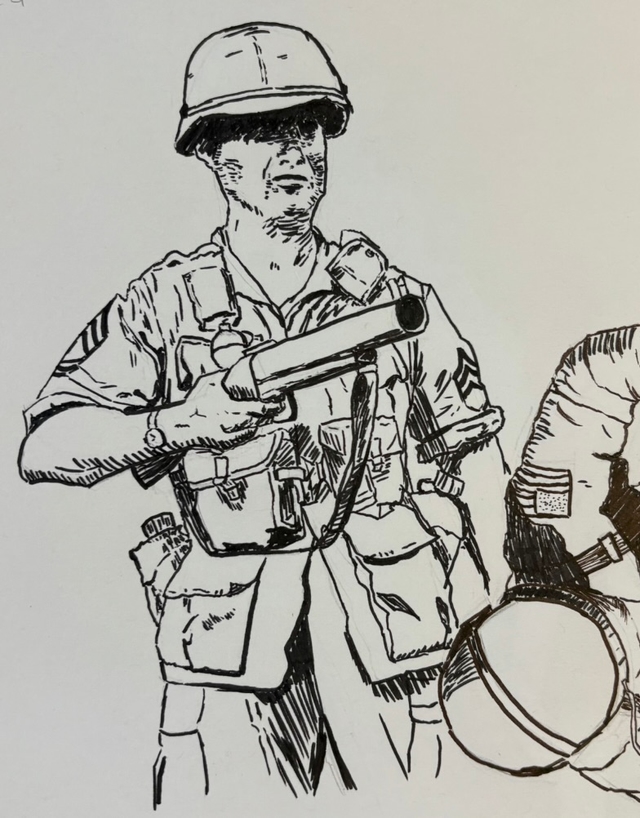
I've been inspired by Karl Kopinski lately so I've started drawing soldiers and astronauts. I had a couple things I wanted to practice with this type of drawing: * Get better at drawing bags, cloth, accessories, etc. * Start with a very loose sketch and then tighten it up in pen, like Kopinski often does. This method of drawing, which I've dubbed _Loose Pencils, Tight Ink_, is fun because it avoids the exhaustive process of creating a detailed drawing in pencil and then having to go over it all in ink. However, it also requires some skill and delicacy since you do not have all the visual information down while inking. Here are a couple other soldier drawings I did with similar aspirations, but these were done with tight pencil sketches or were not inked:  <img src="http://localhost:4321/_image?href=%2F%40fs%2FUsers%2Fjacobarmiger%2Fdev%2Freact-portfolio-site%2Fsrc%2Fassets%2FIMG_0040.jpeg%3ForigWidth%3D4284%26origHeight%3D5712%26origFormat%3Djpg&w=3840&q=100" alt="Two soldiers" style="caret-color: rgb(0, 0, 0); color: rgb(0, 0, 0); font-style: normal; font-variant-caps: normal; font-weight: 400; letter-spacing: normal; orphans: auto; text-align: start; text-indent: 0px; text-transform: none; white-space: normal; widows: auto; word-spacing: 0px; -webkit-text-stroke-width: 0px; text-decoration: none;" width="4284" height="5712">
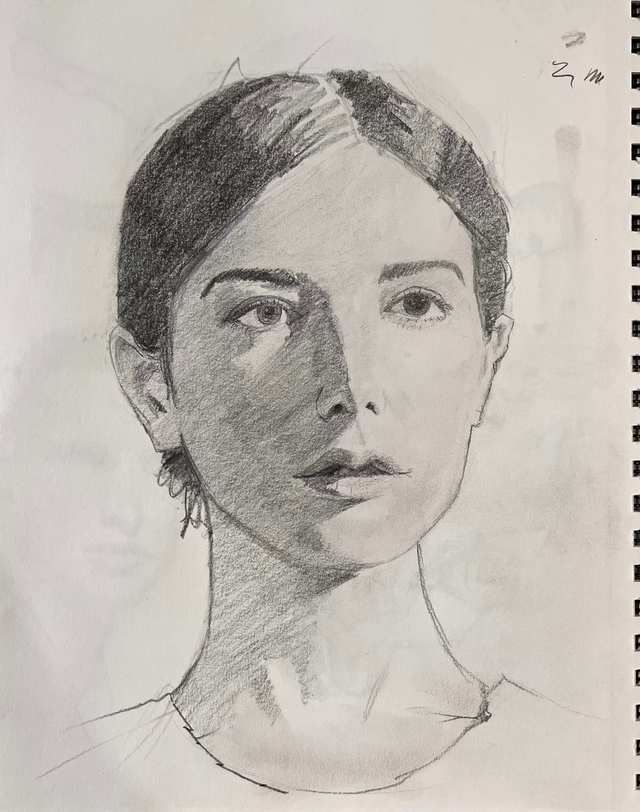
I view this piece as a turning point in my ability to draw portraits. Rendering and values have long been something I’ve neglected to study, but they are inherently important when creating portraits. After watching Katie Maeve draw and really grasping how to see values, my portraits have gotten much better. Part of this understanding of values is the understanding of how to draw facial features with value rather than lines. When you’re drawing lines instead of values, your portraits will end up looking like this:  Date: March 2024 Now while there’s a lot of things wrong with these portraits, you can see that I’m drawing what the art community calls “symbols” for the features of the face, rather than what the features actually look like. I did this most conspicuously with their eyes, which I’ve drawn in almond shapes like many new artists do. In my more recent portrait, you can see that I let white/light value blend into the eyes and lips. That is drawing with value, and it has improved my portraits substantially.
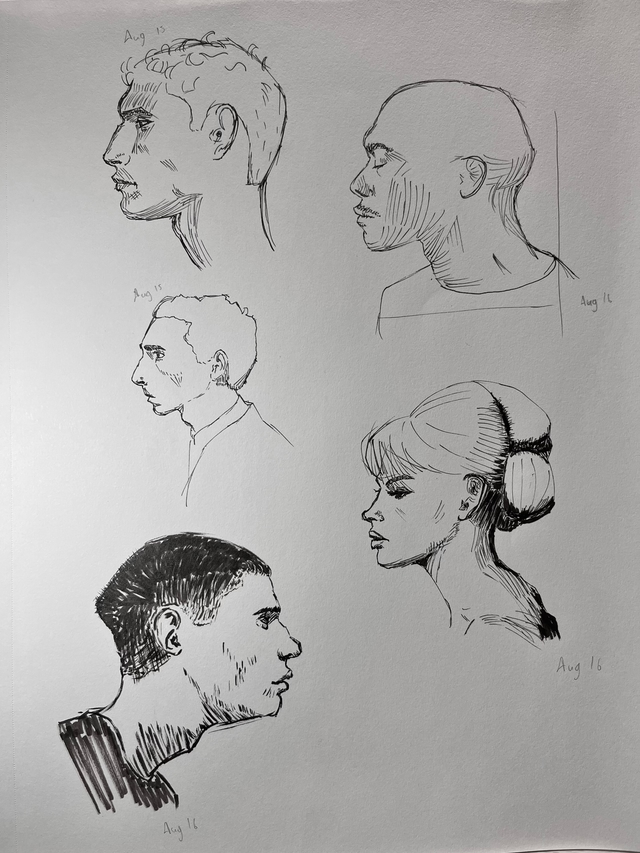
These heads were drawn in ink, no under sketching. Drawing in ink is a skill that people like Kim Jung Gi and Peter Han have essentially mastered. I was much worse at it when I first started practicing this way, but with repetition I’ve gotten better at it, like strengthening a muscle. I’ve asked people which head is their favorite, and I’ve gotten a variety of answers which I think is a sign that these are good. One of my favorites is the smallest head on the left side. I feel that I was able to convey the reference’s facial structure with very few lines. There’s something substantive to distilling complex forms down to as few lines as possible. Although, no one said that head was their favorite, so maybe not.